

People who grow disillusioned with our socio-economic system sometimes come up with bold ideas. That is true for Flemish local Jelle D’Hulster from Oostkamp as well: in 2023 he sold his house, quit his hectic IT job and moved into a bus. From that “Bustronaut” he now offers tailor-made journeys as an alternative to overcrowded group trips. “I’m one of those people for whom the covid period and its aftermath became a fundamental game changer. In the years before 2020, as a single divorced father of three, I had been depleting my reserves for quite some time, pushing every limit. I earned a good living as a freelance software developer, I was paying off my house on the outskirts of Bruges and I just about managed to keep my household running in a hectic life. A first burn-out in 2008 was a warning sign, in 2012 I separated from the mother of my children, but at some point the little voice in my head kept getting louder. I realised I had been telling myself for years that I wouldn’t last another five. It was simply too much. When the lockdowns arrived, they first felt like a blessing: I could work from home more and saved the two and a half hours of driving to clients. But when my two eldest children started studying and moved out, the final blow came: a second burn-out. That was in May 2023. I went to Spain for a week with my new partner and she had to drag me everywhere. She asked me: ‘Honey, could you be depressed?’ I was done.” “Back in Belgium I turned my life completely upside down. I sold my house and, with pain in my petrolhead heart, I let go of my Jaguar F-Type, the second car. I bought a second-hand coach, a 12-metre bus that I began to convert into a home. Last year I tried to work one and a half months as an IT specialist again, but my health still wouldn’t allow it. Even during this conversation I unfortunately need my pills against migraine attacks. I fell back on a small allowance, took time to think and decided to continue the radical break with my past. I actually feel like the canary in the coal mine: the one warning that the whole system is collapsing because I see so many people and things crashing around me. With my mix of burn-out experience and my own way of observing the world, I see three factors that will fundamentally change our Western lifestyle in the near future. First there is climate change: I know there are believers and non-believers in this debate and I’m among those who don’t pretend to know it all. What I do know, because I see it happening, is that long periods of drought and heavy rainfall can alternate very quickly. And owning a house—a fixed asset—doesn’t let you flexibly deal with a climate that can suddenly flip. Then there is artificial intelligence as the second big rupture. Most people don’t yet realise that it will completely reshape society within five to fifteen years. AI doubles its IQ every six months. A few months ago it was as clever as the smartest person alive, with an IQ around 160. That means that within a few months it will reach 320 and then, another cycle later, 640. It’s an exponential dynamic: all AI systems learn from one another, while humans only build knowledge linearly. And once quantum computers and advances in robotics join in, we might suddenly have flying cars, or other innovations that our human brain can’t even imagine yet. AI may wipe out 80 percent of today’s jobs; if we want to avoid going mad or suicidal because of it, we’ll have to relearn how to connect with Mother Nature and with each other. And finally there is our financial system, which is on the verge of collapse. Our economy runs on a mountain of debt that can no longer be repaid. Look at the United States: that superpower currently pays more interest on its debt than it spends on its army—an army that is still the biggest in the world. At some point it stops: you can’t keep printing money to pay off debt. During my second burn-out I could no longer pay the mortgage on my house, and who will be able or willing to do so in the future? I expect more and more people to walk away from it, and our traditional socio-economic life—the one Western societies have known since WWII—will simply have to change.” “I’m choosing my bus now, even though during a transition period I will rent a house for my sixteen-year-old son and my partner, who don’t want to live in it permanently. But at least I got rid of the crushing mortgage, and that gives me real peace of mind. I’ve renamed my bus the ‘Bustronaut’, complete with a website. I’m still finishing the bathroom, but otherwise I’ve already turned the vehicle into a camper with every modern comfort for four people. This will be my life and my income from now on. The concept is that I plan and announce trips and invite two or three people to join for a fee. I design an itinerary and programme entirely tailored to individuals or couples, pick them up and bring them back to a nearby airport. Travellers won’t feel the pressure or stress of group travel with me—you don’t have to wait for others or rush to keep up. I’ll film everything and put it on YouTube, both for promotion and so that people who can’t come along can still enjoy Europe’s most beautiful places. Together with my travel companions I want to look at our beautiful world with admiration and love, on location. I’m partly inspired by Wim Lybaert’s travel show ‘De Columbus’ on the Flemish public broadcaster VRT. On the first journey I’ve planned I’ll head to Iceland from April 2026 and stay there for three months. Later I’ll likely offer a trip to Puglia in southern Italy, which has become something of a second home because that’s where my partner’s roots lie. And alongside that mobile life I can keep building websites to earn a varied income. Going back to the nine-to-five routine of the past is out of the question: I want to live in the NOW, to create and to enjoy—no longer saving for later, for a pension that in a country like ours isn’t even certain anymore.”
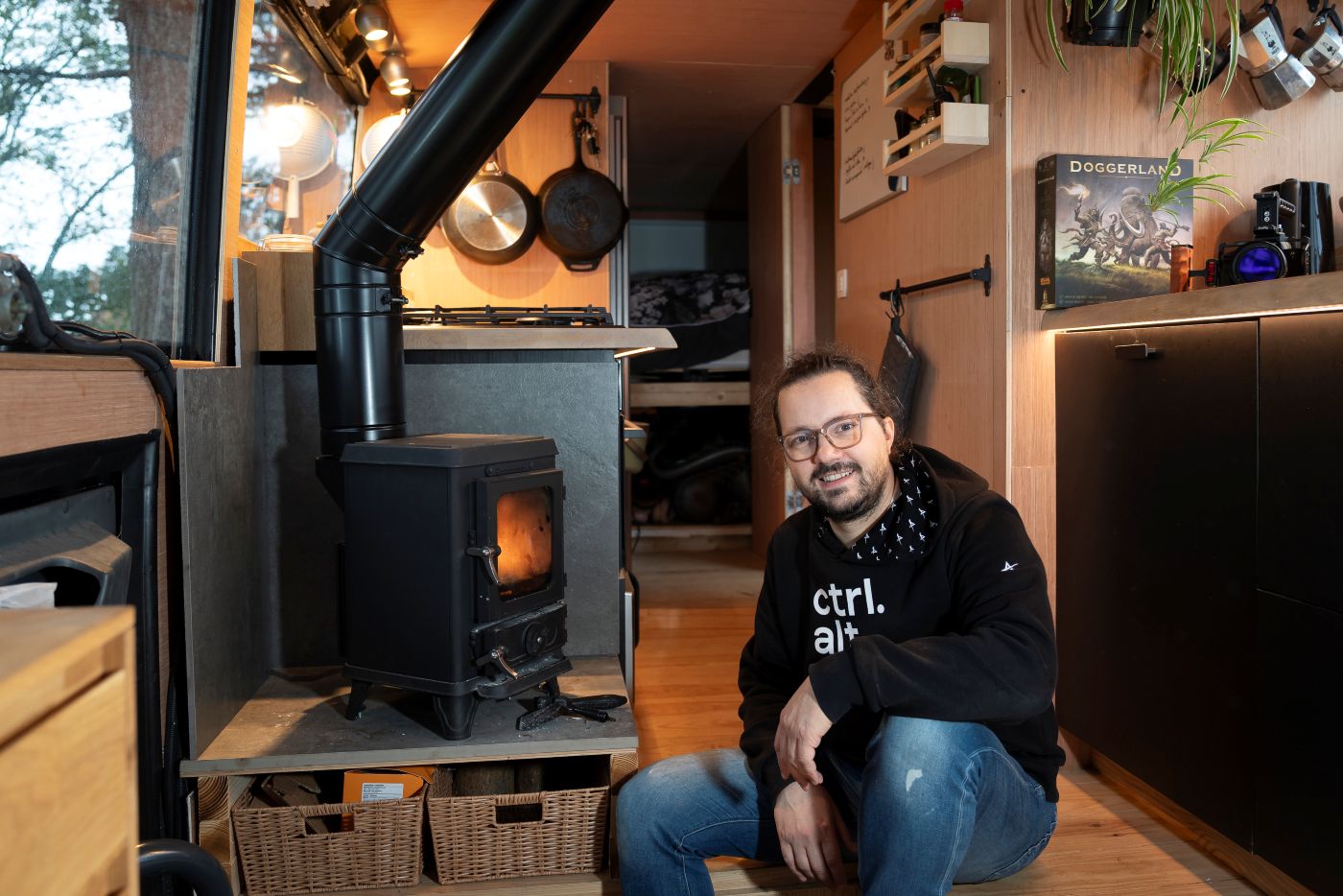
Photo: Peter Stuijck Text: Stefaan